Program: Nauči Kod Youth Programming & Robotics
Instructor: Vladimir Savić
Location: Bosnia and Herzegovina
Implementation Period: February 20 – March 15, 2026
A Moment That Got the Whole Class Excited
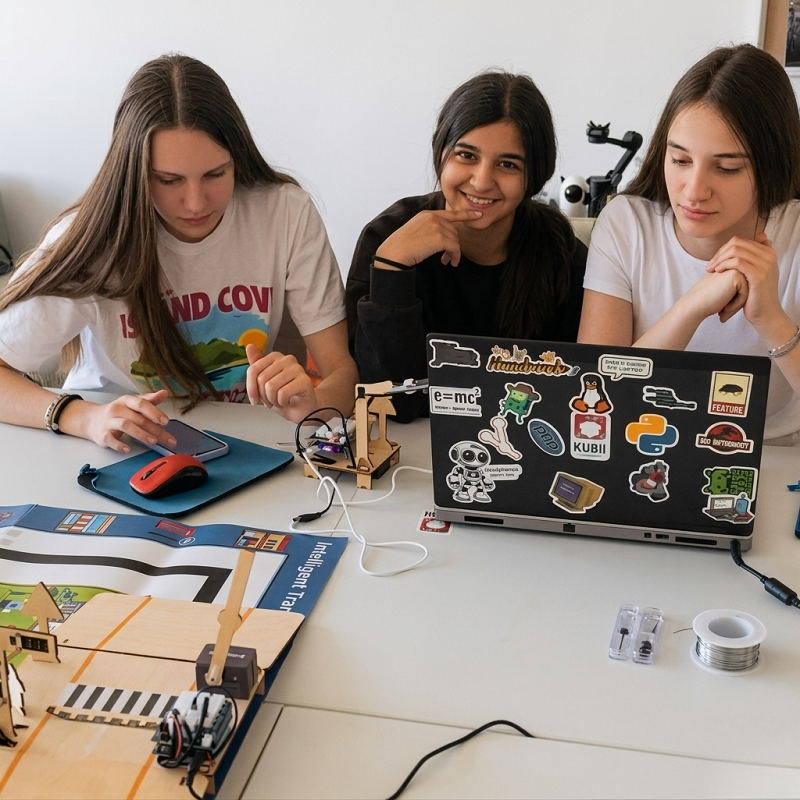
It was an ordinary class. The students were debugging the smart parking module, getting ready to make the servo-driven barrier raise and lower.
The code was written. It compiled successfully. But the barrier turned in the wrong direction—dropping when it should have risen, and rising when it should have dropped.
The instructor didn’t give them the answer.
The students started observing, discussing, and testing on their own. Eventually, they discovered the cause themselves: the servo arm had been physically mounted in the wrong orientation. They repositioned it, ran the program again, and the barrier finally worked as intended.
At that moment, the whole classroom cheered.
In truth, this small “mishap” was one of the most valuable moments in teaching—sometimes taking a detour is itself a form of learning.
This roundabout lesson helped the students truly understand the relationship between hardware and software: code does not exist in isolation; it is tightly connected to the physical world.
About Nauči Kod
Nauči Kod is a youth programming and robotics education program based in Bosnia and Herzegovina, dedicated to helping students aged 10–18 build a solid STEM foundation through project-based learning.
We are committed to making sure students not only know “how to do it,” but also understand “why it works.”
In this course, Nauči Kod integrated the ACEBOTT Intelligent Transportation Kit into a systematic STEM curriculum, rather than treating it as a one-off workshop activity.
This report covers two student groups totaling 8 students, aged 10–14, with each group attending 3–4 sessions of 90 minutes each.
Nauči Kod’s Three-Stage Teaching Method
What impressed us most about the acebott kit is that it can support a progressively layered teaching system. We designed three stages:
Stage 1: Building the Foundation
Students begin with the most basic programming concepts, get to know the ESP32 microcontroller, and learn about the sensors and actuators in the kit one by one. Students with a C++ background move directly into Arduino programming, while others build their understanding through ACECode’s block-based programming environment.
The goal of this stage is singular: to make every student comfortable with the ACECode environment and understand how each component works.
Stage 2: Component Understanding and Guided Practice
Students begin to work more actively with individual components.
ACEBOTT’s official teaching materials are extremely useful at this stage—they clearly explain each component’s function, connection method, and basic use cases.
Building on the official tutorials, we apply a spiral learning approach: the same component is revisited repeatedly, but with increasing logical complexity each time. Students first understand simple behavior, then revisit it with more advanced logic, and finally integrate it into system-level tasks.
At this stage, the ESP32 Shield Board (V1.0) left a strong impression on us. With its clearly labeled ports, it greatly simplified wiring, reduced errors, and made the flow of the class smoother. This meant students could devote more energy to logical thinking instead of wrestling with wires.
We also make sure to tell students that the shield “abstracts away” the underlying circuitry, and that when they later move on to breadboards and discrete components, they will have the chance to explore electronics in greater depth.
Stage 3: System Integration and Real-World Application
This is the most exciting stage. Students begin building a true “mini smart city”:
- Smart Street Light— automatic brightness adjustment based on ambient light
- Smart Traffic Light— complete traffic cycle, countdown display, buzzer alerts, pedestrian button
- Smart Parking— servo-controlled barrier, RFID detection, sensor-triggered automatic closing
- Smart Pedestrian System— crossing logic coordinated with the traffic light
At this stage, students naturally fell into different roles: some wrote code, some tested, some observed behavior, and some proposed improvements. This kind of spontaneous teamwork was a wonderful surprise to us.
What the Students Accomplished
Over the course of this implementation period, students completed the following either independently or with guidance:
Smart Street Light: adaptive brightness control via a light sensor
Smart Traffic Light: full signal cycle logic, countdown display, buzzer integration, pedestrian button interaction
Smart Parking: servo barrier control, RFID card recognition, sensor-triggered automatic closing
Smart Pedestrian System: basic logic implementation
More importantly, they gained:
- An overall understanding of system architecture
- An understanding of how subsystems interact
- Methods for debugging hardware and software together
What the Students Loved Most
Watching these kids react was fascinating. Their most excited moments were almost always tied to “visible output”:
- The traffic lights cycling at the rhythm of a real city
- The countdown numbers ticking down second by second
- The parking barrier slowly rising as an RFID card approached
- The various modules starting to “talk” to each other and work in coordination
When students saw a few lines of their own code bring an entire system to life, the sense of accomplishment was something no abstract programming exercise could ever replace.
Evaluation of the Kit
After this period of implementation, our overall assessment of the ACEBOTT Intelligent Transportation Kit is as follows:
Ease of Use / 8: The hardware design is intuitive, and the shield board in particular significantly lowers the barrier to entry.
Stability / 9: The system runs reliably, with virtually no hardware failures.
Teaching Suitability / 8: Highly effective in the classroom, especially for instructors with ESP32 and Arduino/C++ experience.
What we appreciate most is its performance in demonstrating real-world system integration—it is not an isolated toy, but a miniature smart city. The understanding students gain from it can be directly transferred to real engineering scenarios.
What’s Next
This implementation is only the beginning. Our follow-up plans include:
- Current groups will continue working toward the full system after additional foundational lessons
- Older students will attempt the complete kit, including the SharkBot self-driving vehicle
- The kit will continue to serve as a core teaching tool in our STEM curriculum
We also look forward to exploring more acebott products in future collaborations, especially those related to AI and computer vision—the next frontier in youth programming education.
Closing Thoughts
The greatest value of the acebott Intelligent Transportation Kit lies not in how many sensors it contains or how many lines of code it runs, but in its ability to help a 10-year-old genuinely understand: how programming changes the physical world.
The moment our students discovered the servo was installed backwards, fixed it themselves, and watched the barrier finally work as intended—that was when we knew this teaching approach had succeeded.
We look forward to continuing this jo